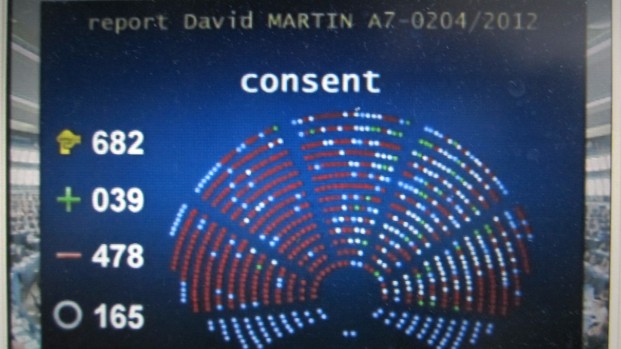
European Parliament votes 478 to 39 to reject ACTA

The vote to reject a delay of the final ACTA vote was 420 Vs 255, followed by the rejection of ACTA by a vote of 478 to 39.
KEI Director James Love statement:
Continue Reading

The vote to reject a delay of the final ACTA vote was 420 Vs 255, followed by the rejection of ACTA by a vote of 478 to 39.
KEI Director James Love statement:
Continue Reading
Earlier this month, the European Parliament and the European Commission released a new compromise text on orphan works.
The Compromise Text is available here:
http://register.consilium.europa.eu/pdf/en/12/st10/st10953.en12.pdf
KEI sees the text as a step backwards for access to knowledge. The proposed directive makes far too many compromises, is too limited in terms of the beneficiaries and uses of works, and creates complicated, burdensome and costly procedures and record keeping requirements.
On 15 June 2012, the World Intellectual Property Organization and the Australian Permanent Mission to the World Trade Organization signed an agreement and released a joint communiqué “detailing how an AUD$2 million Australian contribution would assist least-developed and developing countries improve their intellectual property systems”.
This was the statement delivered by Brazil on 5 June 2012 at the WTO Council for TRIPS under Agenda Item L-Copyright Limitations and Exceptions: Ongoing Negotiations At WIPO-Briefing By Brazil and the United States.
The following is the Brazilian intervention.
Last April, the President of Brazil, Dilma Rousseff, visited the United States.1 5 June 2012: India’s statement at WTO TRIPS Council: Exchange of information on securing supply chains against counterfeit goods
On 5 June 2012, India delivered the following intervention at the WTO Council for TRIPS on agenda item K, “Exchange of information on securing supply chains against counterfeit goods”.
Intervention on Agenda Item KWhat’s a counterfeit? And how many counterfeit drugs are there?
Donald McNeil has an article in the New York Times that appeared in print on May 22, 2012 (page D6 of the New York edition) with the headline: “Malaria: Fake and Substandard Drugs Grow as Threat to Fight Disease.” A web version is available here: http://www.nytimes.com/2012/05/22/health/policy/fake-and-substandard-drugs-grow-as-threat-to-fight-malaria.html
WTO disputes- Intellectual property dimensions of the Boeing case (WT/DS353)
“Roma locuta causa finita est” (Rome has spoken, therefore the case has been decided) was the maxim employed by medieval jurists to describe the absolute irrevocability of papal judgements in canon law. Today, in modern international trade law, the World Trade Organization’s (WTO) Appellate Body fulfills a similar function as the international trading system’s “Supreme Court”. In the words of the WTO,
[t]he Appellate Body was established in 1995 under Article 17 of the Understanding on Rules and Procedures Governing the Settlement of Disputes (DSU). Continue ReadingMore notes on the USTR 2012 Special 301 List
The USTR’s 2012 Special 301 list was published on April 30, 2012. Below are some comments about certain portions of the Special 301 Report that concern access to knowledge and access to medicines.
USTR cites the “TEAM” approach to access to medicines
Continue ReadingUSTR’s 2012 Special 301 Report, focuses on largest developing country markets, and Canada
The 2012 USTR Special 301 Report was published on April 30, 2012. The report details USTR’s unilateral standards for the granting and enforcement for a diverse set of intellectual property rights, and singles out countries that USTR claims do not… Continue Reading
Senator Harkin (D-IA) sends letter to President Obama supporting a WIPO treaty for the visually impaired
On Friday, March 30, 2012, Senator Tom Harkin (D-IA), Chairman of the Senate Health, Education, Labor, and Pensions (HELP) Committee sent a letter to President Obama supporting an international treaty for persons who are visually impaired or have other disabilities. The letter urges the Obama administration to achieve several goals in such a treaty, including robust minimum standards that do not diminish the rights provided for under U.S. Continue Reading