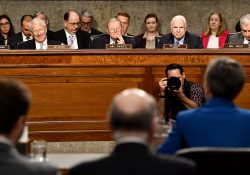
Add some hearings.. 1983 Oversight on implementation of the Orphan Drug Act (Public Law 97-414) : hearing before the Committee on Labor and Human Resources, United States Senate, Ninety-eighth Congress, first session, on reviewing the radioepidemiological tables and thyroid cancer… Continue Reading →
Knowledge Ecology International and 43 other health-care interested groups are calling on Congress to pass the CREATES Act. The CREATES Act, or the “Creating and Restoring Equal Access To Equivalent Samples Act of 2017”, is a bipartisan proposal to speed… Continue Reading →
In a reversal from the version that passed out of the Senate Finance Committee, the version of the tax bill that passed the Senate eliminated the requirement that the Orphan Drug tax credit be transparent as to taxpayer, drug and… Continue Reading →
On 19 July 2017, Rep. Marcy Kaptur (D-OH) introduced an amendment at the markup in the U.S. House Appropriations Committee of the FY2018 State and Foreign Operations, Labor, Health and Human Services Appropriations bill that would direct the Department of Health and Human Services to use its authority to break patent monopolies for government-funded inventions priced higher in the U.S. than seven other high-income countries.
The report of the Senate Armed Services Committee on the National Defense Authorization Act of 2018, S. 1519, published July 10, 2017, includes a directive that links exclusive patent rights to the prices of drugs, vaccines and other medical technologies that are based upon DoD-funded inventions.
The text of the directive, approved unanimously by the full Senate Armed Services Committee, is as follows:
On 30 July 2015 at 8:30 PM Geneva time, the Chair (Bucura Ionescu, Romania) of WIPO’s 22nd Standing Committee on the Law of Patents (SCP) distributed the following non-paper related to the proposal by the Group of Latin American and Caribbean Countries (GRULAC) to revise the 1979 WIPO Model Law for Developing Countries on Inventions. If this language is tabled, WIPO’s normative committee on patents will continue discussions on the GRULAC proposal.
On Wednesday, July 22, 2015, the Senate Veterans Committee held a mark-up to consider several bills. During the mark-up, Senator Sanders offered an amendment, attached below, that would create a compulsory license mechanism in the Department of Veterans Affairs, for patents on medical inventions. (See amendment text below). The motivation for the amendment was a crisis in the VA involving access to drugs for the hepatitis C virus (HCV).
The 1980 Bayh-Dole Act is named after two former US Senators, Birch Bayh and Bob Dole. In 2002 both claimed the Bayh-Dole Act march-in provisions were not intended to address cases where prices for inventions are unreasonable, and Senator Bayh repeated this view during a 2004 march-in case involving Abbott patents on ritonavir.
Among the provisions of the Act that suggest otherwise are the following: