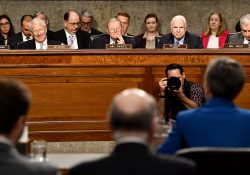
The latest version of the USTR NAFTA renegotiation hearings schedule is out. USTR has a page for the NAFTA hearings, here, which now has the a link to the witness schedule.
There are 26 panels of witnesses over 2.5 days. Doing the math, each witness seems to have less than 10 minutes, including questions from the panel.
The United Nations Human Rights Council (HRC) convened its 35th session from 6 June 2017 to 23 June 2017. During HRC35 (which took place in Room XX of the UN Palais des Nations in Geneva), a group of 21 countries tabled a resolution entitled, “The right of everyone to the enjoyment of the highest attainable standard of physical and mental health in the implementation of the 2030 Agenda for Sustainable Development”. Continue Reading →
As reported by Knowledge Ecology International (KEI), on 6 June 2017, the World Trade Organization (WTO), published a paper tabled by Brazil, China, Fiji, India, and South Africa, entitled “Intellectual Property and the Public Interest.” In their communication (IP/C/W/630), the proponents called for a series of discussions at the WTO TRIPS Council on Intellectual Property and the Public Interest. Continue Reading →
On 31 May 2017, the delegations of Brazil, China, Fiji, India, and South Africa tabled a paper to the World Trade Organization’s (WTO) TRIPS Council entitled “Intellectual Property and the Public Interest.” In their communication (IP/C/W/630), the proponents called for a series of discussions at the WTO TRIPS Council on Intellectual Property and the Public Interest. Brazil, China, Fiji, India, and South Africa proposed compulsory licensing as the first theme of IP and the Public Interest discussions at the TRIPS Council meeting in June 2017.
In the run up to the 70th World Health Assembly (22 May 2017 – 31 May 2017), the World Health Organization prepared a document (A70/INF./4, 16 May 2017) entitled, Voluntary contributions by fund and by contributor, 2016. Total voluntary contributions to WHO in 2016 amounted to $1,717,219,177 which represented a dip from the 2015 figure of $1,836,970,206.
Here is a non-exhaustive list detailing the sources of voluntary contributions to WHO and the size of their respective contributions in 2016.
On Tuesday, 30 May 2017, India, on behalf of the WHO South-East Asia Region, delivered the following intervention on Cancer prevention and control in the context of an integrated approach.
Portugal delivered the following statement at the 70th World Health Assembly on agenda item, 13.3 – Global shortage of, and access to medicines and vaccines.
In relation to the Report of the United Nations High-Level Panel on Access to Medicines (UNHLP), the delegation of Portugal quoted the intervention delivered by the Portuguese Minister of Health, Professor Campos Fernandes at the plenary of the 70th World Health Assembly.
On May 23, 2017, Rep. Jan Schakowsky, D-Ill., asked Dr. Anthony Fauci whether he believed the federal government should use “every tool” to ensure that Sanofi charges a fair price for a taxpayer-funded Zika vaccine that is being developed by the U.S. Army and funded by BARDA.
Dr. Fauci responded that he did not believe that the government had the “mechanisms” to guarantee an affordable price, even when the U.S. government and taxpayers have made a “major investment” in the development of a drug.
KEI has separately uploaded a short clip of the exchange between Rep. Schakowsky and Dr. Fauci:
Additional information on the Army-BARDA-Sanofi vaccine collaboration is available at /zika and /zika-timeline.
After at least eight rounds of negotiation, including two Geneva-based negotiations held on 12 May 2017 and 17 May 2017, the G20 Health Ministers meeting, convened in Berlin from 19-20 May 2017 issued the following declaration.
In relation to the R&D pipeline for developing new antimicrobial therapies, the G20 recognized “the importance of fostering R&D for new antimicrobials, alternative therapies, vaccines and rapid-point-of care diagnostics, in particular for priority pathogens as identified by WHO and for tuberculosis.”